Showing posts with label YouTube. Show all posts
Showing posts with label YouTube. Show all posts
February 14, 2013
January 2, 2011
New Pop PoMo
Nearly two years ago, we created the "blogger's sport" of Building/Song pairings. If you're not familiar with the game, educate yourself with our attempt at an exhaustive list of the game and it's players: (let me know if there are any omissions...)
Science fiction could never have predicted a new millenium saturated with groovy 70's fonts, polaroid photo shoots, arcade 8-bit bliss, and late '80's soft rock electrodiscodance combos. Nevertheless, watching these videos, take note of how typical pomo material (e.g. reinterpretation of nostalgia + multiculturalism) is taken to the next level . These weapons-grade pop samples demand an architecture which is firmly rooted in hybrid realities surrounding truthful (or deceitful) narratives of the past (and future).
1.) The Black Eyed Peas - The Time (Dirty Bit) paired with Neo-Rococo furniture from Smansk:


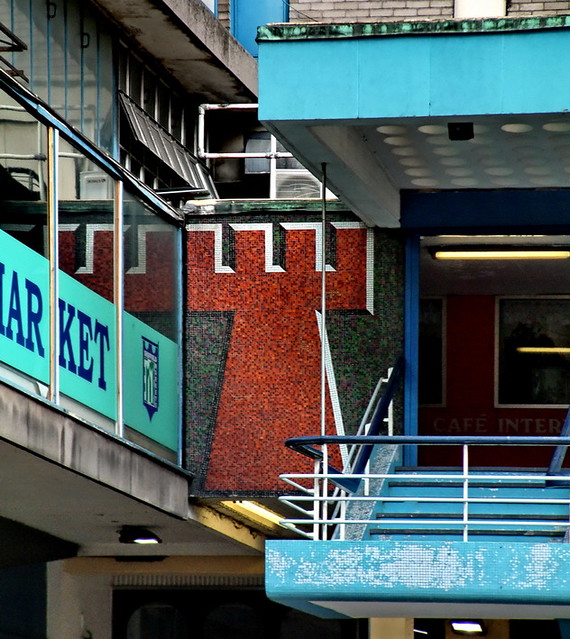
3.) Kanye West - Runaway (2010) paired with Castle Market, Sheffield, 1967


- January 11, 2009 (M: Nostagiolistically Evocational)
- January 27, 2009 (M: More Buildings/Songs)
- January 29, 2009 (FJ: Separated at birth)
- January 30, 2009 (FJ: Sisters)
- January 30, 2009 (SDMYABT: Pop and Brutalism Special)
- January 31, 2009 (FJ: Pop Life)
- February 1, 2009 (M: Pop and Things Like That --> RB: Blanqueford Regenerated (October 2008)
- February 4, 2009 (I: Embedded Linx)
- February 9, 2009 (LWB: Searching for a Definition of Lo-Fi Architecture)
- August 13, 2010 (FJ: parade)
Science fiction could never have predicted a new millenium saturated with groovy 70's fonts, polaroid photo shoots, arcade 8-bit bliss, and late '80's soft rock electrodiscodance combos. Nevertheless, watching these videos, take note of how typical pomo material (e.g. reinterpretation of nostalgia + multiculturalism) is taken to the next level . These weapons-grade pop samples demand an architecture which is firmly rooted in hybrid realities surrounding truthful (or deceitful) narratives of the past (and future).
1.) The Black Eyed Peas - The Time (Dirty Bit) paired with Neo-Rococo furniture from Smansk:


Within today's globalized, network urban world, the music video begins with the futurism of outer space juxtaposed with the sampling of a soft rock song from the late 1980's. The aesthetics of the video flash into a heady blend of google street view, drug-infused pixelization, and avatar hallucinations all packaged with an aged, nostalgia-inducing photo filter (also see The Black Eyed Peas - Light Up The Night for the co-opting of '80s arcade nostalgia with QR Code overlays). It's agenda is to convey happiness through maximum visual stimulation and hypnotic beat. Neo-Rococo, as artistic style closely resembles the 'Peas' attempt at space/time maximalism. Sorry, no building here, but a successful curatorial performance in my opinion.
2.) Lady Gaga - Paparazzi (Nov, 2009) paired with Café Was in Hollywood, CA (2009)


Not much can be said about Lady Gaga that has not already been said in this delightful experiment. She's into challenging gender (and celebrity) identity roles, the aestheticization of tragedy, haute couture, etc. Best put here:
At the start of the video, as Gaga is shown plummeting from the balcony to the ground in slow motion, a synthesizer sonority enters emulating Gaga’s heartbeat; moments later, the listener is inundated with the sound of paparazzi anxiously snapping away at their cameras. The snaps and clicks combined with the pulsating heartbeat create their own distinct rhythmic pattern, and persist until they meld seamlessly into the song’s ostinato bass line – a slightly simpler version of the initial rhythm. Thus, we can say that the beat propelling the entire song grew out of both Gaga's heartbeat and the snapping and clicking of the paparazzi, a resonance that is at once organic and fabricated – an important dichotomy in this video.
Café Was in Hollywood, CA designed in 2009, featured in Dark Nostalgia, addresses Gaga's experimentalism and theatricalism, and is perhaps the first of many Gagaian spaces to emerge. From Café Was' website:
A Unique Hollywood Architectural Experience: Enter a reflective dream world, sensitive and severe, always seductive and never overt, where you are invited to enjoy delicacies while discovering new talent
Cafe Was is a thoughtful amalgam of "recycled" architectural/interior design related ideas. We assembled these ideas in varying stages of deconstruction and whimsy, ultimately creating a theatrical environment in the form of a restaurant/live music venue, where not only the piano player, but the patrons as well, will be compelled to play a role.
With a revolving grand piano at the center of the room, Ivan Kane and RKIT set about to create an opulent, bohemian dream world. The diverse space offers several options where patrons can dine, including multiple levels surrounding the piano. While achieving a collaboration of time in both design and style, including columns at the ground floor turning into Victorian posts at the intimate mezzanine level overlooking the piano below, Café Was also features hidden lounges tucked into nooks and crannies, a mysterious balcony turned into a lavish candle display and Café Was' most unique vantage point to sit and listen from, a grand staircase leading nowhere.
 |
| Rowe's Transparent Modernism full of Victorian furniture, African chants, and hip hop mixology. |
 |
| The New Postmodernism. |
 |
| Michael Jackson and the Spectacle. |

Notably found within this half-hour self-directed film are African dance rituals paired with 1980s/90s sound mixing technology, and a post-industrial hangar/bunker housing what appears at first glance to be a reinterpretation of the Last Supper (a genre-bursting, symbolically loaded scene highlighted by a 2 minute solo featuring "interpretive ballerina dancing" (within a rusting post-industrial hangar) to a spoken melody broadcast via 80s-era sound distortion technology):
"There is a dinner table scene that jumps from [something] from a Noah Baumbach film — where the camera stays on the scene just long enough to make the viewer feel a little bit uncomfortable — to something out of what could be a Jim Henson creation ... within the same scene too." - Pete Wentz, reporting for MTV News
Ultimately West's film is about "social ostracism and rebirth". As we've mentioned earlier, the architectural equivalent to such themes is undoubtedly brutalism as both idea and aesthetic. So for this pairing, Sheffield's endangered Castle Market (a building I've never visited and only read about) wins. It's association with a movement whose aims are decidedly utopian and whose aesthetics are a radical departure from the heritage industry, make this place as polemic as Kanye himself (Apologies to both purist hip hop enthusiasts and architectural historians alike - two groups who probably rarely associate with one another). On the one hand you have West - and his thirty minute effort to rebel against the culturally constructed symbolism (queue Hennessy Youngman) of our day. On the other hand, Castle Market, whose brutalism (with a touch of mid-90's PoMo leftovers) overlaid on the foundations of Sheffield's authentic/original castle create the 20th century reinterpretation of the 16th century castle: a civic monument via defensive infrastructure.
November 9, 2010
Slow and Steady Wins the Race
nice piece of writing over at Frieze Mag:
Perhaps the truest screw heir is Paul Octavian Nasca, a Romanian programmer who wrote the software used to create recent viral hit ‘U Smile 800% Slower’ (2010) – a Justin Bieber track stretched to 800 percent of its original length while the pitch remains unchanged. A Florida-based electronic musician used Nasca’s algorithm to smear the three-minute single into a half-hour epic of shimmering, sensual ambience. Bieber-haters and his legions of fans were equally enthralled by the transformation, which made the Canadian teen star’s corn-syrup pop sound like Icelandic band Sigur Rós. In less than a month, it was heard by more than two million people, received the endorsement of Mr Bieber (he tweeted: ‘this version of u smile is incredible to just chill out and fall asleep to. feels epic’), and spawned copycat slowdowns. - Jace Clayton, Music: The slowed-down tempos of screw and its influence on contemporary bands
October 9, 2010
Ohio Swiss Fest: A Photo Essay
Sugarcreek, Ohio is a tiny town about 2 hours north of Columbus, Ohio. It consists of a spectacular Alpine Village nestled amidst the endlessly rolling hills of Amish country. But what sets this place apart from other rural towns of Middle America is a bustling cheese industry and an unexpeted dose flaboyantly decorated buildings. I recently visited this "Little Switzerland of Ohio" and have returned triumphantly with what I hope to be a dazzling photo essay.


We have finally arrived! Welcome to Sugarcreek, the Little Switzerland of Ohio!

Main Street is full of buildings like the one pictured above, however none are as large or impressively ornate as the Alpine Hills Museum: a must-see destination inside and out for visitors of all ages.


Vintage posters, newspaper articles, and children's depictions of Sugarcreek can be found among historical re-creations of Amish interiors and old cheese-making barns.

The interior lobby of the Alpine Hills Museum is a bizarre mash-up of general country nostalgia/folk art, Swiss heritage, and conservative Middle America propaganda. This space is perhaps the epicenter of Sugarcreek's identity: a place where one would expect Google's little red map pin to land while searching for Sugarcreek, Ohio. Nevertheless, this space projects the dark, unsettling side to Sugarcreek: for this is a non-place, torn between conflicting identities of Swiss heritage and Middle American conservatism. Celebrate cheese, chocolate, and those omnipresent snowcapped Alps, but don't you dare fly that red and white crossed flag!

Pure spectacle, but unfortunately the world's largest functioning cuckoo clock (debatable) is currently being restored. Thankfully, there's always YouTube.


Architecturally, the most impressive area of Sugarcreek can be found at the intersection of Main St & Factory St. It is here that artist Tom Miller has created fantastic murals on the gabled facades of commercial buildings. The Swiss Alp landscapes are highlighted by moving model trains and alpine skiers. The concept of motion in architecture is witnessed here at a most miniature scale. A whole building provides the canvas for a motorized small piece of metal. I call these fantastic pieces of art "active facades" and have uploaded a couple of examples over on YouTube.


As for the actual festival, 8 million pounds of cheese are annually produced in Sugarcreek, which create the (desperate) need for a massive event to sell all of the excess cheese reserves. Many different awards are given, but to the average cheese eater such as myself, it is all mouthwateringly (?) delicious. This region also produces wine, but I would (politely) defer similar high praise to the California varieties.


There were all sorts of spectacles to witness including a "cheese chase" (5K run), grown men wearing traditional Swiss folk gear, an Alphorn concert, a Steintossen competition, and a curiously American-themed parade complete with an impressive car show of hot rods and post-war gas-guzzling muscle cars.


The winning float in the parade was provided by McDonald's. Who knew Ronald McDonald was so crafty!? A late afternoon visit to McDonald's revealed that Sugarcreek's Swiss Miss Main Street spirit had begun to penetrate the global superpower's cookie cutter red and yellow boxes. A surprising end to an equally surprising (but unfortunately brief) visit to Little Switzerland.
September 30, 2010
"Architect"
First search result on YouTube for "Architect"...
p.s. I'll be attending Ohio's very own "Swiss Festival" this weekend: a 50+ year old tradition that originated in Amish Country due to the understandably dire need to sell excessive cheese. Needless to say, the festival is held in what is considered to be the Little Switzerland of Ohio. I'll be tweeting on scene using the tag, #swissfest, and will subsequently be posting a review of my architectural discoveries here in due time.
p.s. I'll be attending Ohio's very own "Swiss Festival" this weekend: a 50+ year old tradition that originated in Amish Country due to the understandably dire need to sell excessive cheese. Needless to say, the festival is held in what is considered to be the Little Switzerland of Ohio. I'll be tweeting on scene using the tag, #swissfest, and will subsequently be posting a review of my architectural discoveries here in due time.
August 24, 2010
October 10, 2009
YouTube As Cultural Vault
It is not often that the Mockitecture Weblog gets to debut a project or artist. Or at least one that anyone else would like to debut.
As the first decade of the 21st century comes to a close (yikes), YouTube has established a prominent role in pop culture. Started as a hosting site, it has quickly become much more. The role of the site has changed dramatically, including a transformation of its use, battles over its use, and the emergence of its meta-use. Within YouTube exists a survey of the current human condition. Reality TV, DIY movies, post-MTV music videos, etc. mesh with rapidly expanding social media. YouTube is not just a media, its is a medium. Many videos on youtube are in response to other videos, and a whole culture has developed within and around it.
YTDJ420_69 has encapsulated the idea of an international cultural vault in his live performances. From the artist's website...
Within the format, many issues arise. The idea of chance, not knowing the next video's exact contents is exciting. When mixing, the overlap is the key relational element. A YJ cannot match beats, nor achieve production slickness, so the relationships of individual pieces are much more arbitrary. Further, the amount of information is doubled in YJing. The addition of visual material makes a fourfold matrix of overlay. Because YJing is performed on the fly, there is no way to know exactly what will happen. Chance takes over.
Also, DJ culture is critiqued. Anyone can be a DJ now. Forget turntables, if you have a computer, you're a DJ. Phil Oakey said about early Human League, "We thought we were the punkiest thing going at the time. We didn't even bother to learn to play guitar. We were using one finger." YJing is a part of the disintegration of internet culture. Uh Oh.
Also, the global experience economy is explicitly expressed by and finessed out of the defining internet application of our time. The limits of YouTube are, well, there are no limits. (In George W Bush voice) It is the virtual vault for all cultural artifacts, as well as a working storehouse of ideas. There are very few things as global as YouTube.
The beauty of the meta-use of YouTube and this technique is that when performed live and projected on a wall or screen, the audience can see everything that the YJ is doing on the screen.
As the first decade of the 21st century comes to a close (yikes), YouTube has established a prominent role in pop culture. Started as a hosting site, it has quickly become much more. The role of the site has changed dramatically, including a transformation of its use, battles over its use, and the emergence of its meta-use. Within YouTube exists a survey of the current human condition. Reality TV, DIY movies, post-MTV music videos, etc. mesh with rapidly expanding social media. YouTube is not just a media, its is a medium. Many videos on youtube are in response to other videos, and a whole culture has developed within and around it.
YTDJ420_69 has encapsulated the idea of an international cultural vault in his live performances. From the artist's website...
"Part performance piece, part improv DJ set, and part video art, YTDJ420_69 creates a meta-use collage of youtube videos, incorporating youtube's infinite pool of video, music and historical footage. Uniquely tailored to each circumstance, the live YJing events can be anything from poorly executed DJ set to moving cinematographic masterpiece."
Within the format, many issues arise. The idea of chance, not knowing the next video's exact contents is exciting. When mixing, the overlap is the key relational element. A YJ cannot match beats, nor achieve production slickness, so the relationships of individual pieces are much more arbitrary. Further, the amount of information is doubled in YJing. The addition of visual material makes a fourfold matrix of overlay. Because YJing is performed on the fly, there is no way to know exactly what will happen. Chance takes over.
Also, DJ culture is critiqued. Anyone can be a DJ now. Forget turntables, if you have a computer, you're a DJ. Phil Oakey said about early Human League, "We thought we were the punkiest thing going at the time. We didn't even bother to learn to play guitar. We were using one finger." YJing is a part of the disintegration of internet culture. Uh Oh.
Also, the global experience economy is explicitly expressed by and finessed out of the defining internet application of our time. The limits of YouTube are, well, there are no limits. (In George W Bush voice) It is the virtual vault for all cultural artifacts, as well as a working storehouse of ideas. There are very few things as global as YouTube.
The beauty of the meta-use of YouTube and this technique is that when performed live and projected on a wall or screen, the audience can see everything that the YJ is doing on the screen.
July 8, 2009
Non-Candidate for Mayor! Local Mockitect Invades the Political Arena
Hats off to non-candidate for mayor, Jason Haap, whose dropping out of the mayor's race saved Cincinnati, OH over $400k (with now two instead of three candidates for mayor, the city will not have to conduct an early and expensive mayoral primary).
In a move that seems fit for Urban Prankster, Haap presented the city with a large fake check for the money he saved them! ... oh, and by the way...he's running for the school board instead (all you mockitect-leaning voters).

Perhaps the city should build a Haap Memorial with the $$$ it saved? It's really the best way to thank him.
June 25, 2009
Controversial Cartoon Books
After a recent trip to Frisch's, a local cafe-of-sorts, for an all-you-can-eat breakfast on borrowed money (long story), I became captivated by the children's coloring book placemat my friend and I were given. It featured, of all things, dinosaurs with one of the city's architectural landmarks, Union Terminal, in the background!

WOW, I thought...kids of all ages are being treated to a fantastic meal AND are learning about the city's architectural heritage all in one happy event. THIS is what will put the profession of architecture back on the map!!! After some quick research back at the office, I discovered this children's cartoon has some controversial company.
Most notably, FEMA - the United State's disaster management organization - released an infamous cartoon coloring book, titled "A Scary Thing Happened" to the eWorld after 9/11 featuring burning buildings and the twin towers under attack by commercial airlines. Soccer moms nationwide were pissed, and rightfully so! If you have a free two minutes & eight seconds, check out the enjoyable YouTube video below.

Already inspired, I stumbled across more equally frightening coloring book imagery - this time religious-based. Scenes of friendly dinosaurs accompanied by bible verses from the book of Genesis had me trembling.
I came to a couple of key conclusions. The first being, children's coloring books are a creative source of propaganda that ALL governments, religious institutions, etc. should be aware of and exploit to their full advantage. The second being I will NEVER let my kids near crayons and coloring books...EVER.
In response to all of these controversial coloring books, and in the spirit of Contemporary Space's (CS13) recent "Greetings From Cincinnati" opening, I decided to make a coloring book of my own, after all, why not put on a clinic for all of Cincinnati's spoiled little brats? The following pages celebrate everything from the Queen City's colonization of Native American tribes, to our overly-industrialized landscape. CS13 and others doing a fantastic job at cleaning up Cincinnati's image after media attacks year after year were not too pleased with my work. I hope you are repulsed and offended by the following as well.

March 31, 2009
Goodbye, March
March is over. It has been a slow month in the wacky world of Mockitecture. Don't worry, though. Things will pick back up soon. Here is one last random mildly design related video, which happens to be hilarious.
March 24, 2009

February 17, 2009
 The
The 

February 4, 2009
February 1, 2009
Pop and Things Like That
After reading this post from Owen, of South East London, connecting post-punk with brutalism, and this post, by Charles, more Building-Songs are in order.
If architecture is a part of the contextual condition which leads to pop, and therefore helps to dictate the course of music written in such a context...
 The broken glass, boarded up windows, and dark alleys along with authoritarian housing projects like Cabrini Green definitely portray the underpinnings (anger and poverty) of the early 90's gangsta rap movement.
Maybe a little dark, but I thought it was a pretty good Building-Place/Song. Perhaps architecture has always been ahead of its time, and therefore has failed to meet the goals of its intended users because the social conditions change so quickly. By the time conditions are right for Modernist social housing, the buildings are already outdated? This is a huge success of PostModernism. Going back to the Charles Moore/Soul Train pairing, perhaps Moore and Venturi were on to something. When architecture looked to pop, it "slowed down" and became humanist again. The incorporation of playfulness and pleasure relates well to Pop.
 On a lighter note, this is the elementary school that I attended. Parkside Elementary, Columbus, IN. Look at the beautiful grass, the trees, and the curvy entrance. A suburban dream. Nintendo music, while imported from Japan, is a kind of audible PCP, made to entrance children into their dreamy suburban existence. Even the MIDI structuring of the music suggests the modernist rigidity seen in Parkside's bay system.
Or maybe that concept would be more fitting if you knew that there was a brutalist elementary school that was our rival. Southside Elementary, 1969 by Eliot Noyes.

I am not saying that Nintendo music was explicitly made in a conspiracy from the Japanese ministry of education and Nintendo, but the cultural constructs, which govern and tie together architecture, pop, music, government, etc. infuence music and architecture, and are also influenced by each.
If architecture is a part of the contextual condition which leads to pop, and therefore helps to dictate the course of music written in such a context...
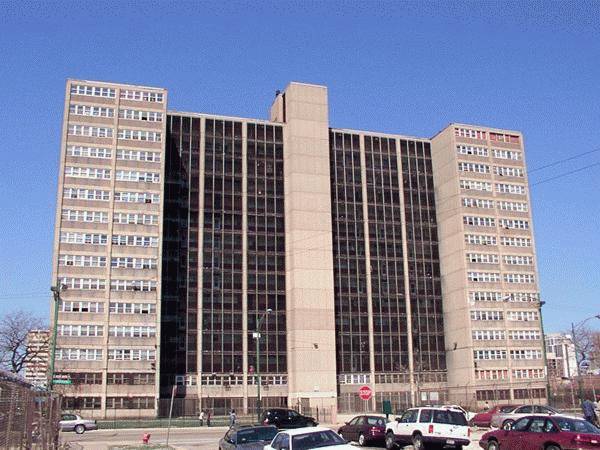 The broken glass, boarded up windows, and dark alleys along with authoritarian housing projects like Cabrini Green definitely portray the underpinnings (anger and poverty) of the early 90's gangsta rap movement.
 On a lighter note, this is the elementary school that I attended. Parkside Elementary, Columbus, IN. Look at the beautiful grass, the trees, and the curvy entrance. A suburban dream. Nintendo music, while imported from Japan, is a kind of audible PCP, made to entrance children into their dreamy suburban existence. Even the MIDI structuring of the music suggests the modernist rigidity seen in Parkside's bay system.
Or maybe that concept would be more fitting if you knew that there was a brutalist elementary school that was our rival. Southside Elementary, 1969 by Eliot Noyes.

I am not saying that Nintendo music was explicitly made in a conspiracy from the Japanese ministry of education and Nintendo, but the cultural constructs, which govern and tie together architecture, pop, music, government, etc. infuence music and architecture, and are also influenced by each.
January 27, 2009
More Building/Songs
Per my colleague Mr. Holland's request for more "haunting digital emptiness", here is Harold Faltermeyer's Axel F (1984) and OMA's Beverly Hills Prada Epicenter (2004). This is a wonderful piece of nostalgia. I especially enjoy the headless mannequin and the laser beam lights.

April 20, 2008
Mockitecture 101
As we realize more and more the extent and implications of mockitecture, actual projects are manifesting themselves at a pacy pace. Here is a preview of what is to come in the next couple weeks. Create your own mockitecture anywhere you would like, and let us know about it.
Subscribe to:
Posts (Atom)