By creating a four minute video of himself eating a hamburger, Warhol - among many other things - transformed an act of ordinary stature into something quite extraordinary. It's been suggested that Warhol was mocking his status as a celebrity artist, but perhaps he was just showing us that no matter how hard he tries, he will never be able to create something that is not valued. He consumes a hamburger, we consume his art; he is "famous," we equate his work with value.
But just how much can the value of an object be pushed? And once value is increased, does it not become that much more desirable? Is "high" art really just "low" art with a mislabeled price tag, sold to an unsuspecting public?
Monica Narula of Delhi-based Raqs Media Collective explored just this topic in a 2006 installation where viewers encountered a stack of postcards in a museum quality display case in front of a large sign reading "please do not touch the art." The ordinary, unassuming postcard transforms into an object of desire - accessible yet inaccessible all at once.
My point in all of this is that the making of meaning can be more important than meaning itself. An object is only as beautiful as you are led to believe.
It is not often that the Mockitecture Weblog gets to debut a project or artist. Or at least one that anyone else would like to debut.
As the first decade of the 21st century comes to a close (yikes), YouTube has established a prominent role in pop culture. Started as a hosting site, it has quickly become much more. The role of the site has changed dramatically, including a transformation of its use, battles over its use, and the emergence of its meta-use. Within YouTube exists a survey of the current human condition. Reality TV, DIY movies, post-MTV music videos, etc. mesh with rapidly expanding social media. YouTube is not just a media, its is a medium. Many videos on youtube are in response to other videos, and a whole culture has developed within and around it.
YTDJ420_69 has encapsulated the idea of an international cultural vault in his live performances. From the artist's website...
"Part performance piece, part improv DJ set, and part video art, YTDJ420_69 creates a meta-use collage of youtube videos, incorporating youtube's infinite pool of video, music and historical footage. Uniquely tailored to each circumstance, the live YJing events can be anything from poorly executed DJ set to moving cinematographic masterpiece."
Within the format, many issues arise. The idea of chance, not knowing the next video's exact contents is exciting. When mixing, the overlap is the key relational element. A YJ cannot match beats, nor achieve production slickness, so the relationships of individual pieces are much more arbitrary. Further, the amount of information is doubled in YJing. The addition of visual material makes a fourfold matrix of overlay. Because YJing is performed on the fly, there is no way to know exactly what will happen. Chance takes over.
Also, DJ culture is critiqued. Anyone can be a DJ now. Forget turntables, if you have a computer, you're a DJ. Phil Oakey said about early Human League, "We thought we were the punkiest thing going at the time. We didn't even bother to learn to play guitar. We were using one finger." YJing is a part of the disintegration of internet culture. Uh Oh.
Also, the global experience economy is explicitly expressed by and finessed out of the defining internet application of our time. The limits of YouTube are, well, there are no limits. (In George W Bush voice) It is the virtual vault for all cultural artifacts, as well as a working storehouse of ideas. There are very few things as global as YouTube.
The beauty of the meta-use of YouTube and this technique is that when performed live and projected on a wall or screen, the audience can see everything that the YJ is doing on the screen.
While we're on the subject, I would call David Byrne a serious practitioner of mockitecture. He straddled the line between serious and silly, meaning and non-meaning, familiar and exotic. The first example of this is in his musical stylings. they incorporated many many different kinds of music from all over the world, exotic blends of rock, country, afro-pop and latin. but in the end, a beautiful, identifiable end product was produced. It reached across age and cultural boundaries. His lyrics did the same, but they took on the opposite philosophy. The lyrics usually were superficially silly, and seemingly had no meaning. They usually were about completely ordinary things. Lamps, post offices, dry ice factories. This is the harmonious dichotomy of Byrne's music. A touching Love Song sung to a lamp. Seriously Goofy.
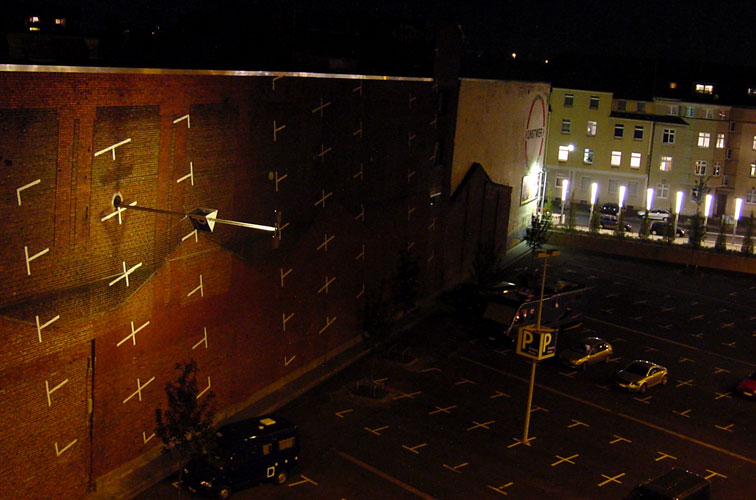
This is a good video about some beautiful "reverse graffiti." It also has a great moment where English artist "Moose" tells us about the inspiration for his work. It is at the 1:29 mark. [more...]
An Australian artist, Maurice Agis, who created what visitors called a "psychedelic cathedral" is being charged with manslaughter after two people died in his giant, walk through art installation titled Dreamspace. The inflatable building was torn off its rope ties by strong winds, collapsing the structure harming many people inside. Read more about it here. The official website for the art piece is nothing more than a blank page with large black text reading, "Web-Page Temporarily Closed. All DREAMSPACE exhibitions have been cancelled." Extinction.
So how does this psychedelic cathedral relate to mockitecture? Certainly this is no hot dog-shaped hot dog stand, nor any other example of comical regionalism. DREAMSPACE (obnoxiously and officially spelled in all capital letters, sorry...) is a redefinition of religion as we know it. Taking one of the most traditional and highly symbolic forms of architecture, the cathedral, and radically redesigning the experience is a monumental achievement any mochitect dreams of creating. Maurice Agis created a disorientingly abstract space through manipulating light, color, form, movement, and sound. All of our preconceptions about the church have been thrown out the window and in fact, the design is so radical that visitors describe their sense of time being thrown off. They explain the variety of spaces encourage exploration from walking, to running, to sitting and laying down. Taking in this obscure experience certainly warrants a great deal of time. To greatly summarize this place which will no longer be, it is a place which embraces what I like to call "sensory overload."
Mockitecture is full of sensory overload, producing overwhelming moments throughout the design. It contains a great deal of obscurity, non-traditional design, and most importantly challenges the current practices of architecture. So the question becomes, if radical enough, can mockitecture kill?