May 18, 2010

Steamboat Gothic

Before roadside vernacular, there was riverside vernacular more accurately described as "Steamboat Gothic." This style came to existence almost entirely as a product of adaptive reuse of otherwise boring structures into delightfully playful objects of desire. The Floating Palace, circa 1888, embodied the glamour and popularity of Steamboat Gothic: instant nostalgia, if there is such a thing.


In 1873, the White House was retrofitted with Victorian ornamentation, interestingly mocked by some who downplayed the changes, labeling the new style as a degrading "steamboat gothic" rather than a more civically-pleasing "pure Greek" style.  Nevertheless, an impressive online gallery of images can be found at the White House Museum.  In the 1950's, the White House was stripped down to it's bare structure in (what I would like to imagine) was a fit of rage by emerging Modernists.  It's about time for a steamboat gothic resurgence.

Images from American Shelter, by Lester Walker.

May 16, 2010

Fancy Home Styles

Apologies for an absence of posts lately. I've been sifting through some old Sears Catalogs (circa 1910-1920) and have some curious, but certainly rambling thoughts which quite honestly do the topic no justice at all. Nevertheless...


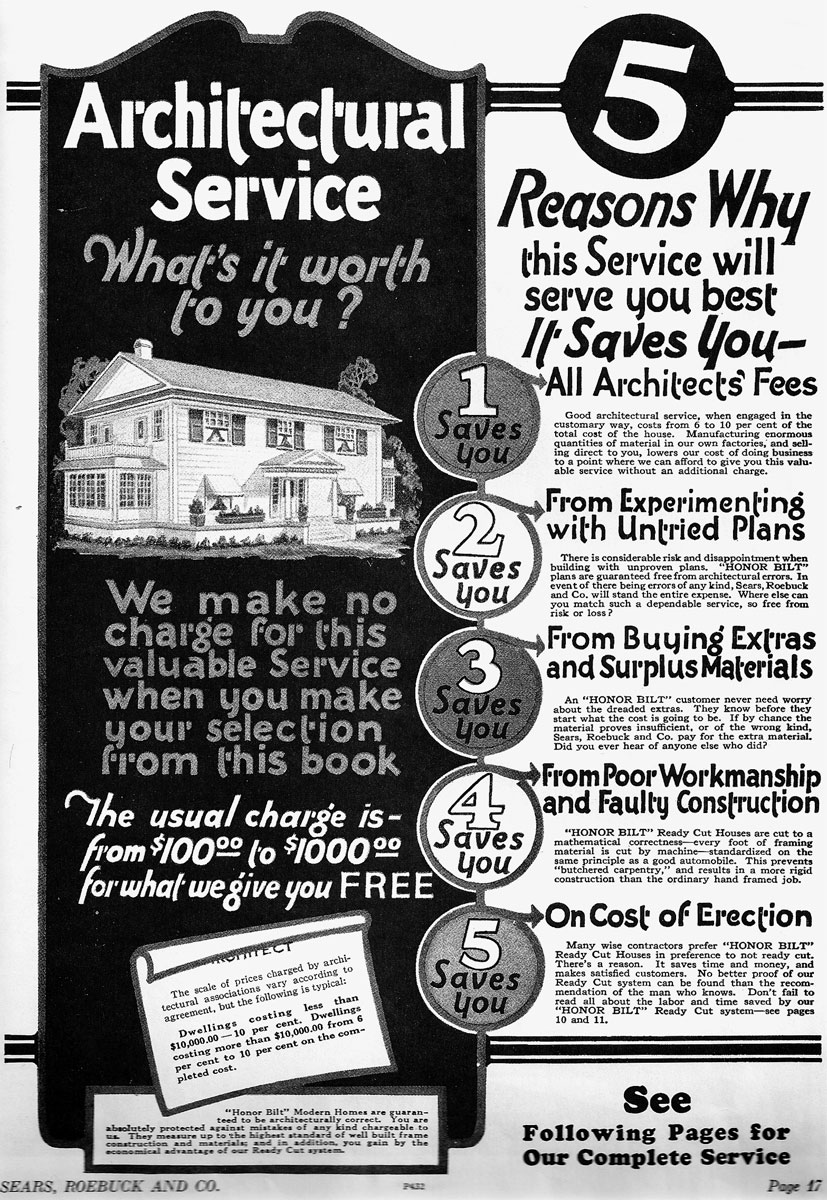
This advertisement should make architects tremble with fear: "Architectural Service: What's it worth to you? We make no charge for this valuable service..."  It appears that the catalogs would have effectively shut out the architecture profession from operating in the design of suburbia.  Despite being a recklessly naive statement, I still can't help but wonder if Sears' timely role in suburban development doesn't have some affect on today's lack of interest in suburban design and development.


The Sears Catalogs were a sort of super-firm, providing "architecture" for free by prescribing a series of carefully selected styles, 22 to be exact, in a mass-produced method. The perfect compliment to Henry Ford's Model T, which debuted the same year as the first catalog.


Reflecting the nostalgia of an assortment of European vernacular (vernaculaii?), the catalogs exist as a form of early pop art; elaborately conceived objects of desire accessible to a mass audience at a delightful price. But were the Catalogs liked or disliked by practicing architects at the time? And how did they affect the profession?  I can't help but wonder if there were rogue architects at the time who attempted to challenge Sears' model of home production.


Finally, I can't help but wonder if "green" design will embrace the same architecture-meets-capitalism agenda of Sears, Roebuck & Co.  LEED may have already co-opted the system of building by catalog components: a green roof here, bicycle parking there, etc.

April 24, 2010

Making Meaning

Andy warhol eating a hamburger:

By creating a four minute video of himself eating a hamburger, Warhol - among many other things - transformed an act of ordinary stature into something quite extraordinary.  It's been suggested that Warhol was mocking his status as a celebrity artist, but perhaps he was just showing us that no matter how hard he tries, he will never be able to create something that is not valued.  He consumes a hamburger, we consume his art; he is "famous," we equate his work with value.

But just how much can the value of an object be pushed? And once value is increased, does it not become that much more desirable? Is "high" art really just "low" art with a mislabeled price tag, sold to an unsuspecting public?

Monica Narula of Delhi-based Raqs Media Collective explored just this topic in a 2006  installation where viewers encountered a stack of postcards in a museum quality display case in front of a large sign reading "please do not touch the art."  The ordinary, unassuming postcard transforms into an object of desire - accessible yet inaccessible all at once.
My point in all of this is that the making of meaning can be more important than meaning itself.  An object is only as beautiful as you are led to believe.

April 15, 2010

You're In Boot Country Now, Son

Behold, a decorated suburban ranch building. It brings to the commercial strip a refreshing mash-up of dazzle camoflauge and country nostalgia, Boot Country is a western themed store specializing in cowboy boots & hats for suburbanite cowboys (a fascinating demographic). Nevertheless, we need more aesthetically experimental buildings such as this:


An example of well-designed cow patterning: a large centralized spot conveniently covers an unsightly vent.


A bit of the stylized cow patterning from the prominent front facade made its way to the side of the building as if to thank the curious onlooker for exploring the depths of the building.  This is the best vantage point to take in the diagonal "work" themed yellow-black striping.  The pattern is mirrored along the center peak of the gable roof, wrapping smoothly around the building without breaking stride. 


A nice roadside sign with typography that bends and curves to fit the shape of a boot.

April 13, 2010

Adventures at Carnival Island

Carnival Island has been open for only two months, yet is quickly becoming an iconic local establishment.  Locals may recognize the Carnival Island name as it was open in years past, however this year a greatly expanded menu has helped to create an entirely new experience.  What is most satisfying about Carnival Island is their commitment to the local community.  Nestled among car dealerships, community colleges, and big box retailers, Carnival Island's unlikely location is one of  it's biggest strengths.  The corporate office park like setting provides a convenient dining option for nearby businesses and students.  This summer, the restaurant plans to provide extended hours to serve a crowd of baseball players from nearby ball parks. 

The approach to Carnival Island is most deceptive. Things that will run through your head while navigating to this miniature sized carnival food eatery is: 1.) Google Maps have deceived me; 2.) Car salesmen must love carnival foods; 3.) The restaurant is desperately in need of a sign as big (or bigger than) their building. 

Ice cream stands have a long history of uniquely attractive aesthetics and Carnival Island does not disappoint.  The overall design of the building is just as unexpected as the eatery's location. It is essentially a mobile home outfitted with restaurant equipment and flashy decoration. A water theme dominates the design of the exterior: applied wavy water graphics (perhaps inspired by Cincinnati's official flag?), an offset steamboat paddle wheel-styled roof canopy, all surrounded by Boise State blue landscaping pebbles.

Alternative design ideas could have incorporated faux palm trees, and/or steamboat gothic extreme ornamentation.

And what about the food? I opted for the "Carnival Fries" because of their catchy name and the footlong hot dog sans chili due to the fact that I would be eating while driving (a tricky act made all the more dangerous due to the elongated size of my meal). I passed on the ice cream, which gives me a good reason to return in the summer.

All in all, Carnival Island - in all of it's authenticiy and mystique - has the potential to become a suburban equivalent of Los Angeles' famous Pink's Hot Dogs  What is needed is more experimentation with the menu, and an expanded identity (specifically it's signage & packaging is lacking).  If you're in southwest Ohio, check it out.

April 6, 2010

Carnival Island

Driving through a landscape of parking lots and aging big box retailers, I discovered utopia, otherwise known as "Carnival Island." Coming soon, some thoughts and images about one of the most bizarre places I've seen. In the meantime, enjoy these:

March 26, 2010

Slide the Slides for Free!

Chester Park was a late 19th century/early 20th century amusement park in Cincinnati, Ohio.  It featured a variety of spectacles ranging from a large man-made watering hole, horse racing tracks, and large victorian pavilions. Pictured below is a miniature railroad uncomfortably packed with eager pleasure-seekers.  Circling a large lake, the mini-train would pass by a replica of the Statue of Liberty (note its un-oxidized copper hue color). Ironically the park closed due to an unpaid water bill, and is now the site of the city's public water department (sadly, the miniature train no longer exists).

One of the most quirky attractions, pictured below, was a rather squat cylindrical building with a comparatively small stick-framed windmill attached purely for decorative pleasure.  Wrapping around this curious building was a two-story metal slide. The purpose of the building - aside from being an elaborate armature for a playground slide - is unclear.  

March 24, 2010

Going Gaga for Google

Google's recent announcement to install fiber optic cable systems in at least one American city has unexpectedly unleashed a firestorm of creativity from want-to-be towns of the future.  An entertaining 4 minute news segment from NPR reveals that aside from Topeka, Kanasas' name change to Google, Kansas, many other cities are desperately trying to get Google's attention.  From mock press conferences, to ridiculous publicity stunts, to catchy jingles, to parades; you name it, they've done it.

Quite frankly, we're envious of all the fun everyone else is having.  In response, we've devised our own plan (unofficially on behalf of Branson, Missouri. Their Chamber of Commerce can thank us later). Why Branson? Why not!? Architectural spectacles seem to be at home in Branson. A new city hall building will quite literally put them on the map.

It turns out, designing a Google-themed architectural monument is quite easy, as Google has already done much of the work for us.  First, our building is selected from a variety of pre-established templates.  The classic red map pin icon will do just fine for our project...

Next, we perform a simple Google Maps search for Branson, Missouri which effortlessly provides us what appears to be the towne centre.  Just like that, in 0.25 seconds, we have generated the site for Branson's new administrative headquarters.

And voilà, our building magically appears! It looks beautiful :) 

Branson's City Hall will have a commanding presence over the city below: a powerfully iconic building amidst one of America's greatest collections of iconic buildings.

Surrounded by the vast range of Ozarkian Mountains, only one question remains...when will the fiber optic cables be installed???